
What is OLED and How Does OLED Display Work?
OLED stands for Organic Light‑Emitting Diode. It is a self‑emissive display technology, fundamentally different from LCD’s backlight‑driven design.
An OLED panel consists of multi‑layer nanoscale organic thin films sandwiched between an anode and a cathode. Controlled by the TFT backplane, the anode injects holes (positive charge carriers) and the cathode injects electrons (negative charge carriers). Holes and electrons migrate through functional layers and recombine inside the emission layer, forming excitons. When excitons decay, they release photons to generate visible light. Red, green and blue sub‑pixels light independently, mixing colours to form the final image.
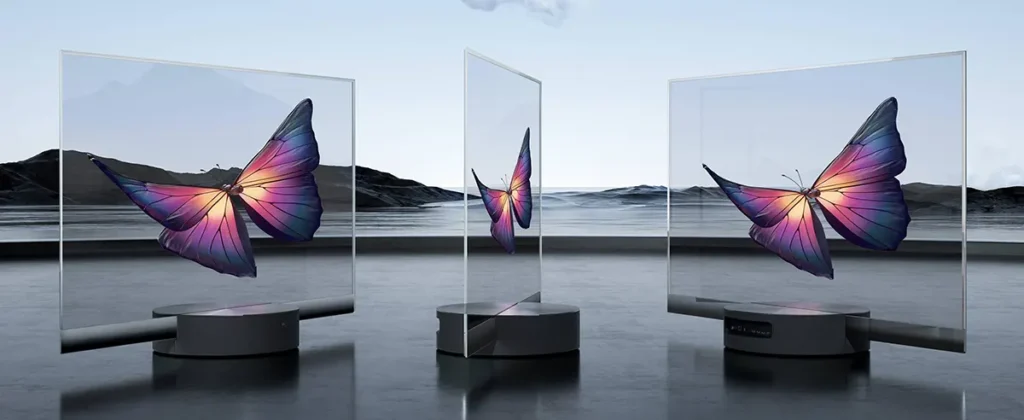
Each pixel can turn on or off individually. For transparent OLED variants, electrode and stack optical design is optimized to maintain light transmittance while retaining luminescence. This makes transparent OLED ideal for shop windows, exhibition showcases, glass partition interactive signage and premium retail displays.
What Core Materials Are Used for OLED Panels?
OLED stacks are ultra‑thin, with total organic film thickness ranging from 100 nm to 500 nm. All materials require strict purity, matched energy levels and excellent resistance to moisture and oxygen. Even tiny water vapour ingress will cause dark spots and permanent pixel failure.
- Substrate: Rigid OLED panels use alkali‑free glass; transparent OLED cover glass usually adopts chemically strengthened glass (not thermal tempered glass) with high flatness, low warpage and ≥90% transmittance. Flexible OLED uses PI polyimide film.
- LTPS / LTPO TFT Backplane: Thin‑film transistor array that switches every sub‑pixel. LTPS delivers high carrier mobility for mid‑to‑large transparent OLED signage.
- ITO Anode: Indium tin oxide transparent conductive film for hole injection. It requires low sheet resistance, high light transmission and uniform etching. Poor ITO etching leads to bright lines or uneven patches.
- Organic functional layers (core stack):
- HIL: Hole Injection Layer
- HTL: Hole Transport Layer
- EBL: Electron Blocking Layer
- EML: Emission Layer (RGB host + dopant, phosphorescent PhOLED is mainstream for high efficiency)
- HBL: Hole Blocking Layer
- ETL: Electron Transport Layer
- EIL: Electron Injection Layer Organic raw materials must reach 99.99%+ purity, with stable thermal performance and low crystallization tendency.
- Cathode: Thin Mg‑Ag alloy or aluminium composite layer. Top‑emission and transparent OLED use ultra‑thin cathode to balance conductivity and transparency.
- Encapsulation materials: TFE thin‑film encapsulation (alternating inorganic Al₂O₃ / SiNₓ and organic layers) or glass frame seal with UV adhesive. WVTR target is 10⁻⁶ g/(m²·day) to block water and oxygen.
- Auxiliary materials: Custom polarizer, optical clear adhesive, touch film, driver IC and FPC. Transparent OLED often uses modified polarizers to reduce reflection without killing transparency.
What Is the OLED Production Process and Key Process Requirements?
OLED manufacturing has six major stages: TFT backplane fabrication, vacuum evaporation, encapsulation, singulation, module bonding and reliability ageing. Vacuum evaporation and thin‑film encapsulation are the highest technical barriers.
- TFT Backplane Fabrication Mother glass cleaning → repeated deposition, photolithography and etching to pattern LTPS transistor arrays and ITO anode circuits. Micron‑level precision is required; backplane yield directly affects panel cost.
- High‑Vacuum Thermal Evaporation (Core Process) Substrates enter a vacuum chamber at ~10⁻⁶ Pa. RGB organic materials are evaporated and deposited through FMM fine metal masks. Mask thermal deformation and alignment accuracy are critical for pixel yield. Transparent OLED has tighter alignment tolerance. All organic deposition runs in inert, water‑free atmosphere.
- TFE Encapsulation Right after evaporation, multi‑layer inorganic‑organic stack encapsulation is applied to isolate moisture and oxygen. Flexible OLED uses TFE only; rigid transparent OLED can adopt glass frame sealing with laser UV curing.
- Singulation, Breaking & AOI Inspection Mother panels are cut into single cells, then initial lighting inspection removes dead pixels, short circuits and leakage defects.
- Module Assembly Cleaning → polarizer / touch film lamination → ACF bonding, COG / COF driver IC and FPC attachment → frame and mechanical assembly. At YUSUN SMART, we deliver finished all‑in‑one transparent OLED kiosks and signage instead of bare panels or raw modules.
- Ageing, Reliability Test and Final QC High‑temperature burn‑in, thermal cycling, humidity test and optical uniformity calibration. Panels with abnormal brightness decay or image sticking are screened out before final assembly.
OLED vs LCD: What Are the Differences?
LCD relies on a permanent backlight unit. Liquid crystal cells only act as shutters to control how much backlight passes through colour filters and polarizers. LCD cannot turn light off completely, so black levels are always grey.
| Comparison Item | OLED (including transparent OLED) | Standard LCD |
|---|---|---|
| Light principle | Self‑emissive, pixel‑level switching | Backlight driven, passive light modulation |
| Contrast ratio | Up to 1,000,000:1, true deep black | 1000:1 ~ 5000:1, grey black |
| Response time | <0.01 ms, almost no motion blur | 5–14 ms, ghosting on fast motion |
| Colour gamut | DCI‑P3 95%+ | SRGB 72%–90% (QLED LCD can reach high gamut but black stays limited) |
| Viewing angle | Consistent colour and brightness at wide angles | Brightness drop and colour shift at off‑axis angles |
| Thickness & form factor | No backlight stack, ultra‑thin, flexible, transparent ready | Thick backlight + optical film stack; transparent LCD has poor transparency |
| Power consumption | Black pixels shut down fully, low power for dark scenes | Backlight stays on, power consumption does not drop with dark content |
| Limitations | Burn‑in risk for static long‑term content (mitigated by pixel shift & content rotation) | No burn‑in, but limited black performance and form flexibility |
What Are the Commercial Advantages of OLED, Especially Transparent OLED?
For B2B commercial display projects, transparent OLED creates a unique selling point that LCD cannot match.
- Superior image quality: Pure black background, high saturation and clean motion for luxury retail, museum exhibits and high‑end lobbies.
- Transparent display capability: Users can view physical products behind the screen while digital content overlays on the glass. This is the core differentiation for showcase and window projects.
- Slim structure: No bulky backlight, easier for wall‑mount, freestanding and flush embedded installation.
- Smooth interactive experience: Ultra‑fast response paired with capacitive touch works well for wayfinding and control panels.
- Ready‑to‑deploy all‑in‑one delivery: YUSUN SMART provides fully integrated transparent OLED signage. We do not sell bare modules. System integrators avoid complicated panel tuning, optical matching and driver debugging.
Conclusion
OLED generates light through organic charge recombination. High‑purity organic materials, precision vacuum evaporation and hermetic encapsulation define its technical threshold. Compared with LCD, OLED dominates in contrast, response speed, viewing angle and form freedom. Transparent OLED is a high‑value niche inside commercial display, targeted at premium retail, exhibition and glass partition projects. YUSUN SMART supplies transparent OLED all‑in‑one interactive signage for global system integrators and brand project contractors.